


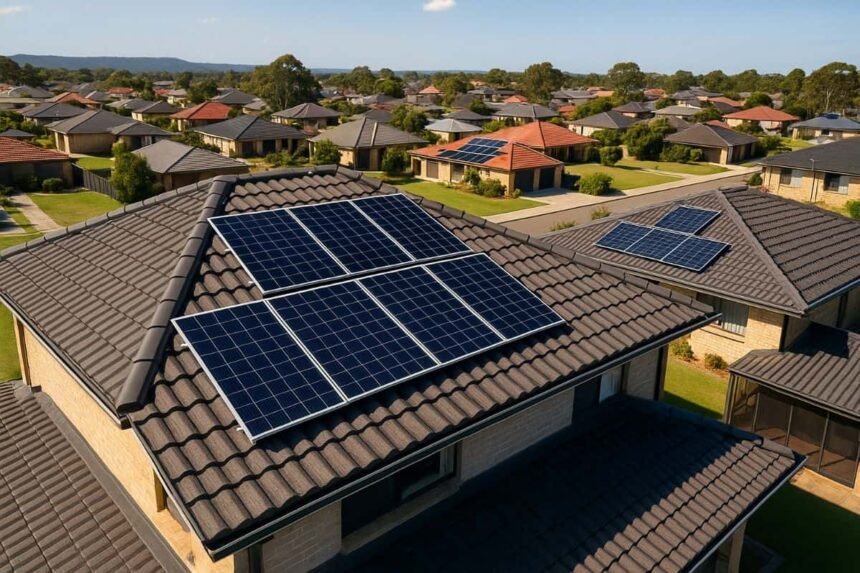
If you are considering investing in domestic solar power, you may be wondering whether solar panels can fully power your home. The short answer is that they can in some circumstances, but the reality depends on several factors, including your household’s energy usage, the size of your solar system, and how much sunlight your property receives throughout the year.
- How Do Solar Panels Power Your Home?
- Is It Possible to Meet All of Your Energy Needs?
- The Importance of Solar Battery Storage
- What Factors Affect Solar Coverage?
- Your Energy Consumption
- Roof Size and Available Space
- Roof Orientation and Shading
- Location and Weather Conditions
- How Much of Your Electricity Can Solar Panels Cover?
- The Benefits of Partial Energy Independence
- So Can Solar Panels Fully Power Your Home?
While many homeowners can significantly reduce their reliance on the grid with solar panels, achieving complete energy independence requires careful planning and, in most cases, additional technologies such as battery storage.
How Do Solar Panels Power Your Home?
Solar panels generate electricity by converting sunlight into usable energy. This electricity can be used to power appliances, lighting, heating systems, and other electrical devices within your home.
During daylight hours, your solar panels produce electricity whenever sunlight reaches them. If your home is using electricity at the same time, the solar energy generated can be consumed directly. This helps reduce the amount of electricity you need to purchase from your energy supplier.
Any surplus electricity that is not used immediately can either be exported to the grid or stored in a solar battery if one is installed.
Is It Possible to Meet All of Your Energy Needs?
In theory, a sufficiently large solar panel system can generate enough electricity over the course of a year to match your household’s total energy consumption. However, generating enough energy annually is not the same as being completely self-sufficient every day.
Solar panels only produce electricity when there is daylight. Generation levels are typically highest during the spring and summer months and lower during autumn and winter. As a result, there may be times when your system produces more electricity than you need and other periods when additional energy is required from the grid.
For many households, solar panels can cover a significant proportion of annual electricity demand, but complete independence is less common without additional energy storage solutions.
The Importance of Solar Battery Storage
A solar battery can play a key role if your goal is to maximise self-sufficiency. Battery storage allows you to store excess electricity generated during the day and use it later when solar production is lower, such as during the evening.
Without a battery, surplus electricity is usually exported to the grid. With a battery, more of the energy you generate can be used within your home, reducing the need to import electricity at night.
While battery storage can increase your level of energy independence, it does not guarantee that your home will be completely powered by solar energy throughout the year.
What Factors Affect Solar Coverage?
Several factors influence how much of your home’s electricity needs can be met by solar panels.
Your Energy Consumption
Households that use large amounts of electricity will generally require a larger solar system to meet their needs. Understanding your annual energy consumption is an important first step when assessing solar potential.
Roof Size and Available Space
The amount of roof space available affects how many solar panels can be installed. Larger roofs can typically accommodate more panels, allowing for greater electricity generation.
Roof Orientation and Shading
South-facing roofs often achieve the highest solar output in the UK. Shading from trees, neighbouring buildings, or other obstructions can reduce system performance and affect overall energy production.
Location and Weather Conditions
Although solar panels work throughout the UK, generation levels can vary depending on local weather patterns and sunlight availability. Homes in sunnier regions may produce slightly more electricity than those in areas with lower levels of annual sunshine.
How Much of Your Electricity Can Solar Panels Cover?
The percentage of your electricity needs covered by solar panels depends on your individual circumstances. Many homeowners find that solar panels can provide a substantial proportion of their annual electricity consumption, particularly when combined with energy-efficient habits and battery storage.
Some households may cover the majority of their electricity usage during the summer months, while relying more heavily on grid electricity during winter when solar generation is lower.
The Benefits of Partial Energy Independence
Even if solar panels do not fully power your home all year round, they can still deliver significant benefits. By generating your own renewable electricity, you can reduce energy bills, lower your carbon footprint, and decrease your reliance on energy suppliers.
For many homeowners, reducing grid dependence is a worthwhile achievement, even if complete energy independence is not practical.
So Can Solar Panels Fully Power Your Home?
Solar panels can potentially generate enough electricity to meet a home’s annual energy needs, but fully powering your home at all times is more challenging. Factors such as energy consumption, roof space, seasonal variations, and battery storage all play an important role.
For most households, solar panels can significantly reduce reliance on the grid and provide valuable long-term savings. If your goal is to maximise self-sufficiency, combining a well-designed solar panel system with battery storage can help you make the most of the renewable energy your home generates.