


The landscape of commercial and industrial lighting has shifted dramatically over the last decade. We have moved away from simple, static illumination toward dynamic, high-density lighting environments that require a sophisticated understanding of both hardware and physics. Designing a lighting system for a large-scale venue whether it’s a high-end retail space, a manufacturing facility, or an architectural landmark is no longer just about “plug and play.” It is an exercise in engineering synergy, where the relationship between the light source and its power conversion system determines the ultimate success or failure of the project.
Engineering Vibrant Environments: The Mechanics of RGB Selection
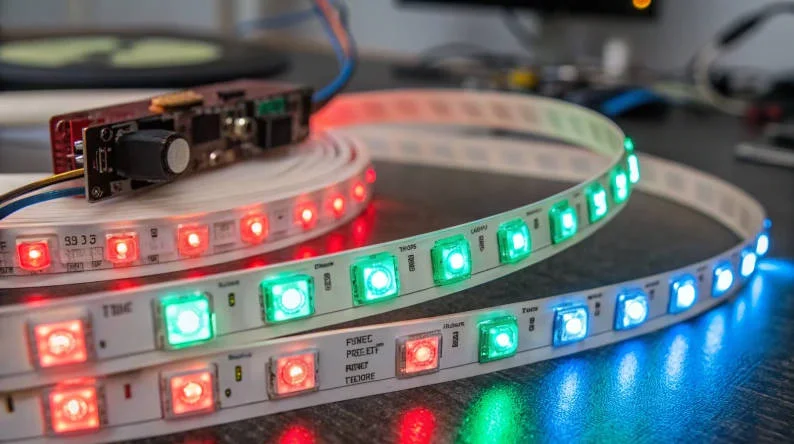
When professionals evaluate RGB lighting, the discussion often centers on color variety. However, from a technical perspective, the focus should be on diode placement and physical integrity. Achieving a seamless “wash” of light without visible hotspots requires a deep dive into diode density. Technologies like COB (Chip on Board) or high-density SMD (Surface Mounted Device) are preferred because they allow for tighter spacing, resulting in superior color mixing even at close range.
Beyond the diodes, the backbone of the system the PCB (Printed Circuit Board) must be robust enough to handle the electrical load. Using a 3oz or 4oz copper thickness helps significantly with heat dissipation. This is particularly vital when sourcing rgb led strip lights bulk for large installations. Procuring in high volumes ensures consistency in “binning,” which is the process of matching LEDs for identical color temperature and brightness. Without this consistency, a large project can end up looking like a patchwork of slightly different hues, undermining the professional aesthetic of the design.
The Role of Constant Voltage in System Stability
While the LEDs provide the visual impact, the power supply is the functional heart of the installation. In professional settings, the power supply is often the most frequent point of failure, usually due to thermal stress or inconsistent voltage regulation. A high-quality driver must do more than just convert AC to DC; it must act as a buffer against the electrical fluctuations common in industrial power grids.
Thermal management in these units is critical. Aluminum-cased drivers are generally superior to plastic alternatives because the metal housing acts as a passive heat sink. By drawing heat away from internal capacitors, the lifespan of the unit is extended significantly. Furthermore, a professional-grade system must incorporate safety protocols such as Over-voltage Protection (OVP) and Short-circuit Protection (SCP). These are not just “extras”; they are essential failsafes that protect the significant investment made in the lighting hardware.
Resilience Against the Elements: Waterproofing Standards
When a project moves from a controlled indoor environment to the unpredictable outdoors, the technical requirements escalate. Moisture is the natural enemy of electrical circuits, leading to corrosion, short circuits, and eventual system blackout. This is where understanding Ingress Protection (IP) ratings becomes mandatory. While IP20 is suitable for a dry office, architectural facades or signage require at least an IP67 or IP68 rating to withstand rain, humidity, and dust.
The challenge lies in ensuring that the entire chain of power remains protected. Using a Waterproof Led Power Supply is a non-negotiable requirement in these scenarios. These units are typically potted with a specialized resin or silicone to completely seal the internal components from the atmosphere. This prevents the “breathing” effect, where temperature changes cause moist air to be sucked into the unit, leading to internal condensation. When combined with UV-resistant silicone tubing for the LED strips, the system gains the resilience needed to perform in harsh climates for years rather than months.
Best Practices for Professional Installation
Integrating these components requires careful planning, specifically regarding voltage drop. In long runs of LED strips, the resistance of the copper traces causes the voltage to decrease as the distance from the power source increases. This results in a noticeable dimming at the end of the line. Professionals mitigate this by using “parallel” wiring rather than “series” wiring, or by injecting power at multiple points along the run.
Furthermore, the control interface of the brain that tells the RGB LEDs what to do relies on Pulse Width Modulation (PWM). By flickering the LEDs at frequencies higher than the human eye can perceive, the controller manages the perceived brightness of each red, green, and blue channel. High-quality controllers ensure this flickering is smooth and flicker-free, even when dimmed to low levels, which is crucial for environments where video recording or photography might take place.
Future-Proofing the Installation
The goal of any large-scale lighting project should be “set and forget.” By selecting components that are matched in specification and built to withstand their specific environment, maintenance overhead is drastically reduced. It is far more cost-effective to invest in high-specification hardware at the outset than to pay for the labor and equipment required to replace a failed driver or a section of degraded LED strip two stories up a building facade.
Ultimately, the reliability of a lighting system is a reflection of the quality of its individual parts. From the thickness of the PCB to the potting of the power supply, every technical detail contributes to a cohesive, durable, and visually stunning result. Following these standards ensures that the installation remains as vibrant and functional on day one thousand as it was on day one.