
Procurement rarely becomes difficult because of a single sourcing event. The strain usually appears after months of growth, when supplier relationships increase alongside contract variations, approval paths multiply without being redesigned, and sourcing activity begins moving through separate teams that operate on different timelines. Procurement teams continue running events, finance continues tracking budgets, legal continues reviewing agreements, yet nobody can easily explain which contract obligations are connected to which supplier commitments. Information exists. It is simply scattered. In many cases, the search for the best procurement software begins only after these operational gaps have already become visible across multiple functions. A growing enterprise often discovers the contract problem long after it becomes operational.
- Procurement Fragmentation Usually Starts Before Contract Risk Becomes Visible
- Why the Types of Procurement Contracts Matter Beyond Legal Review
- What Procurement Teams Usually Mean When Looking for the Best Procurement Software
- Strategic Sourcing Software Changes How Contract Decisions Are Evaluated
- Contract Governance Becomes an Enterprise Procurement Problem
- Final Thoughts
Procurement Fragmentation Usually Starts Before Contract Risk Becomes Visible
Supplier decisions become disconnected from contract decisions.
A supplier may be selected through a sourcing process while contract negotiation happens elsewhere, creating a gap between commercial evaluation and contractual obligations.
Finance sees numbers while procurement sees suppliers.
Spend is monitored, budgets are reviewed, invoices are processed, yet the reasoning behind supplier selection is often buried inside sourcing activity records.
Legal enters the process late.
Contract reviews are frequently performed after commercial discussions have already shaped expectations and delivery commitments.
Approval histories become difficult to trace.
When price changes, supplier exceptions, or the contract terms are altered, it can be a challenge to find the information in several different systems and within several different communication threads. The fragmentation occurs slowly over time.
Why the Types of Procurement Contracts Matter Beyond Legal Review
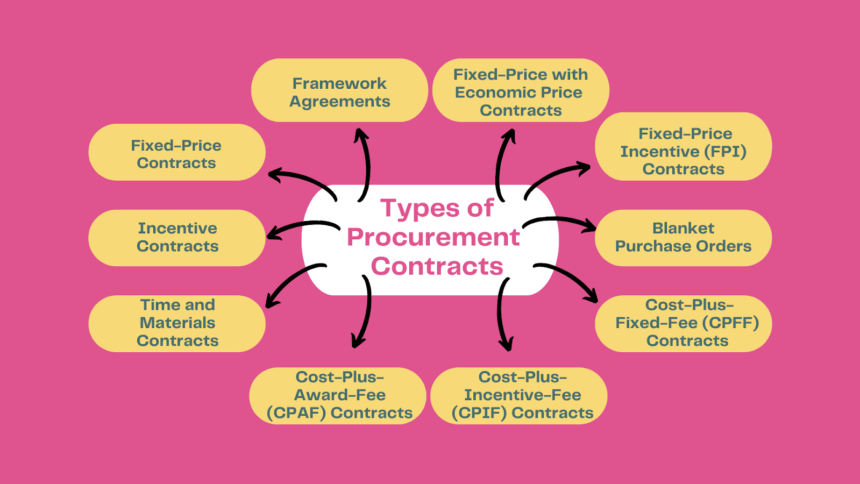
Fixed-price contracts prioritize predictability.
Organizations commonly use fixed-price structures when requirements are clear, although supplier flexibility may shrink once work begins.
Cost-reimbursable contracts shift monitoring requirements.
Greater adaptability is created, but procurement teams usually spend more time validating costs, milestones, and supporting documentation.
Time and materials contracts depend on visibility.
Work can begin before every requirement is finalized, though ongoing oversight becomes part of normal procurement operations.
Incentive-based contracts connect outcomes to performance.
Supplier compensation is partially influenced by delivery targets, service levels, or business objectives established during negotiations.
There are different types of procurement contracts, and the manner in which the risk is transferred from the buyer to the supplier will vary depending on the contract. Strategic sourcing software is being assessed more and more from that perspective. Contract structures have a more impact than it seems on procurement operations.
What Procurement Teams Usually Mean When Looking for the Best Procurement Software
They are often looking for visibility first.
Supplier information may exist in one location, sourcing activity in another, contracts somewhere else, plus approvals inside email conversations.
They are trying to reduce operational ambiguity.
Questions about supplier performance, sourcing outcomes, and contract obligations should not require manual investigation every time.
They need sourcing activity connected to downstream processes.
Procurement events generate information that finance, legal, compliance, and operations eventually depend on.
They are attempting to eliminate procurement blind spots.
Data silos tend to create duplicate work, inconsistent supplier evaluations, and conflicting records across departments.
The search for the best procurement software often begins as a workflow discussion and becomes a governance discussion.
Strategic Sourcing Software Changes How Contract Decisions Are Evaluated
Supplier history becomes easier to access.
The history of sourcing, pricing, negotiation success and supplier performance can be compared to present procurement needs.
Commercial decisions gain operational context.
Procurement teams can now benchmark suppliers on previous outcomes or compare the outcomes from different events.
Stakeholders review the same information.
Finance, procurement, legal, and compliance teams can work from connected records rather than maintaining separate versions of procurement reality.
Contract selection becomes more informed.
Patterns emerge over time. Certain categories repeatedly perform better under specific contract structures, while others consistently create administrative overhead.
Strategic sourcing software is often discussed as a sourcing tool. In practice, contract evaluation quietly becomes part of the same process. Visibility changes behavior.
Contract Governance Becomes an Enterprise Procurement Problem
Renewals are frequently missed for predictable reasons.
Contract information may exist, but ownership becomes unclear once sourcing events conclude and operational teams take over.
Compliance requirements continue expanding.
Vendor documentation, approvals, audits, certifications, and contract obligations accumulate over time without becoming easier to manage.
Supplier coordination becomes more complex.
The number of stakeholders involved in procurement increases faster than most approval processes are redesigned.
Manual tracking eventually reaches a limit.
Spreadsheets can support procurement activity for a period, although contract governance becomes harder once sourcing volume increases across business units.
The same sourcing activity is often reviewed repeatedly by different teams.
Final Thoughts
Is complete procurement visibility being achieved when procurement teams can view supplier performance, sourcing results, contract requirements, approvals, spend decisions and other elements, but only one at a time? The best procurement software is not always determined by procurement transactions. The need to link procurement activity with supplier management, contract governance, compliance, financial controls and stakeholder coordination are key aspects of enterprise procurement operations that are becoming more critical today.
There are types of procurement contracts that affect the division of risk, the assessment of suppliers, the arrangement of approvals, and the ongoing measurement of performance. Strategic sourcing software, therefore, isn’t just about conducting sourcing events, it’s also about keeping the process of the sourcing continuum going with the growing complexity of the sourcing process, the increasing size of sourcing volumes, and the expansion of sourcing supplier networks within the organization. Businesses facing these challenges are now starting to consider platforms that are focused on AI-driven sourcing automation, procurement orchestration, supplier coordination, and connected sourcing workflows that are intelligent for enterprise procurement operations like Procol.