


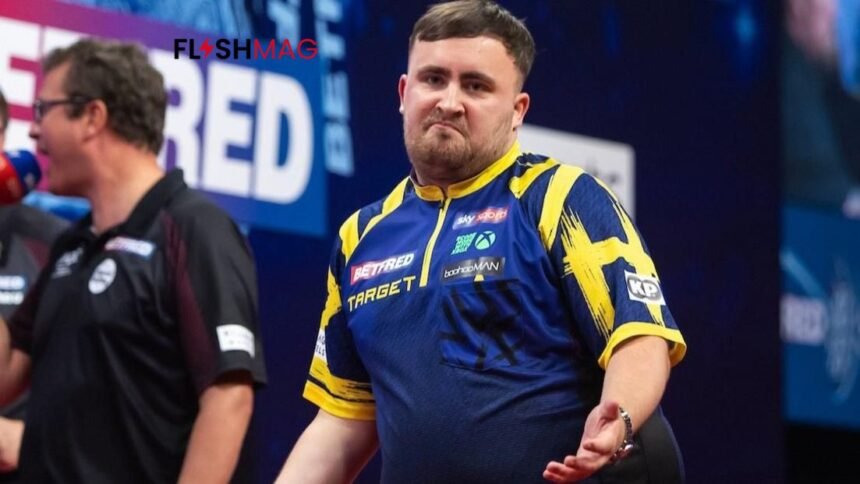
Luke Littler rose from junior darts competitions to the top of the professional game with almost unbelievable speed. At 16, he entered the PDC World Championship as a little-known qualifier and left as one of Britain’s most recognisable sports figures. Within two years, he was a two-time world champion and the world number one.
- A Childhood Built Around the Dartboard
- How Luke Littler Became a Global Sports Story
- Becoming the Youngest World Champion
- What Makes His Game So Difficult to Handle?
- Rivalries, Pressure and the Question of Longevity
- Fame, Personality and Influence Beyond Competition
- A Remarkable Career That Is Still at the Beginning
- Frequently Asked Questions
His age made the story irresistible, but novelty alone does not explain his success. Littler combines heavy scoring, accurate finishing and unusual calm under pressure. He has also proved that his first remarkable run at Alexandra Palace was not a one-off. By August 2026, he had won major titles in set-play, long-format, double-start and league competitions, demonstrating a remarkably complete game.
| Key fact | Detail |
|---|---|
| Date of birth | 21 January 2007 |
| Birthplace | Warrington, Cheshire, England |
| Nickname | The Nuke |
| Professional organisation | Professional Darts Corporation |
| World Championship titles | 2025 and 2026 |
| Playing hand | Right-handed |
| Walk-on song | “Greenlight” by Pitbull, featuring Flo Rida and LunchMoney Lewis |
| Major honour | MBE for services to darts |
A Childhood Built Around the Dartboard
You May Also Read: has said that he first threw darts at about 18 months old, using a magnetic board bought by his father. Such stories can sound like sporting folklore, but his development soon became more structured. He reportedly hit his first 180 at six and joined the St Helens Darts Academy when he was 10.
Competing against older players helped him progress quickly. Junior darts was not simply a casual weekend activity; it gave him experience of match conditions, tournament pressure and the concentration required to repeat a precise action over several hours.
His ability was apparent well before his televised breakthrough. At 14, he won the Irish Open, becoming one of the youngest players to claim a senior World Darts Federation title. He later became the 2022 Junior Darts Corporation world champion. In 2023, he dominated parts of the PDC Development Tour and won the PDC World Youth Championship, defeating Gian van Veen in the final.
Those achievements secured his place at the 2024 PDC World Championship. Although he was new to the sport’s largest stage, he was not an inexperienced beginner. He had already spent years competing, winning tournaments and learning how to close out important matches.
How Luke Littler Became a Global Sports Story
The 2024 World Championship changed everything. Ranked far outside the established elite and listed as a 66/1 outsider before the event, the 16-year-old immediately looked comfortable at Alexandra Palace.
He defeated Christian Kist in the opening round with a performance that made experienced followers take notice. Wins over Andrew Gilding and Matt Campbell followed, but the defining moment of his early run came against Raymond van Barneveld. Rather than being overwhelmed by a former world champion whom he had watched growing up, Littler won 4–1.
Further victories over Brendan Dolan and Rob Cross placed him in the final against Luke Humphries. Littler led 4–2 in sets and came close to moving within two sets of the championship, but Humphries recovered to win 7–4.
The defeat did little to reduce the importance of the run. Littler had become the youngest player to reach a PDC World Championship final. He collected £200,000 in prize money and moved dramatically up the rankings, but the greater change was public recognition. Television audiences who rarely watched darts began following his matches.
More importantly, he responded to sudden fame by winning. In 2024, he claimed the Premier League title, hitting a nine-dart finish during the final against Humphries. He also won the World Series of Darts Finals and secured his first ranking major at the Grand Slam of Darts. Those victories answered the obvious question after Alexandra Palace: he could reproduce his best darts across different venues and formats.
Becoming the Youngest World Champion
Littler returned to Alexandra Palace for the 2025 World Championship as a leading contender rather than a surprise qualifier. Expectations were far higher, and every opponent knew what he could do.
He progressed through the tournament before meeting Michael van Gerwen in the final. Van Gerwen was a three-time world champion and one of the most accomplished players in PDC history, yet Littler established an early lead and maintained control, winning 7–3.
At 17 years and 347 days, he became the youngest world darts champion. The victory broke the overall age record previously held by Jelle Klaasen, who had won the 2006 BDO world title at 21.
His success continued throughout 2025. He added the UK Open, World Matchplay and World Grand Prix to his collection. He also retained the Grand Slam title, a result that helped take him to world number one. By then, the discussion was no longer about whether he belonged among the elite. It was about how far his career might eventually go.
At the 2026 World Championship, Littler reached the final for the third consecutive time. Gian van Veen won the opening set, but the match quickly moved in the defending champion’s direction. Littler won 7–1, becoming only the fourth player to retain the PDC world crown after Phil Taylor, Adrian Lewis and Gary Anderson.
He received the tournament’s newly increased £1 million winner’s prize and, at 18, already owned two world titles.
The following months brought further success. He won the World Masters, defended the UK Open, regained the Premier League title and partnered Humphries as England won the World Cup of Darts. In July 2026, he produced a dominant World Matchplay campaign, defeating Gerwyn Price 18–9 in the final to retain the trophy.
What Makes His Game So Difficult to Handle?
The most visible strength in Littler’s game is scoring. He regularly fills the treble-20 bed and can produce clusters of 180s that place an opponent under immediate pressure. A rival may throw a perfectly respectable 12- or 15-dart leg and still receive no opportunity to attempt a double.
His throwing action is compact and repeatable. There is little unnecessary movement, and his pace is fast without appearing hurried. That rhythm matters because hesitation can disrupt accuracy and encourage a player to think about mechanics rather than the intended target.
Finishing is equally important. Professional matches are not won by scoring alone; a player must convert the remaining total on a double. Littler is comfortable following conventional checkout routes, but he also has the awareness to adjust when a dart blocks part of the board or lands in an unintended segment.
Another advantage is his ability to switch targets confidently. If treble 20 becomes obscured, he can move to treble 19 or treble 18 without losing rhythm. This makes his scoring less vulnerable to awkward dart placement.
His temperament may be the most striking quality of all. He has played finals in front of large, noisy crowds and rarely appears trapped by the significance of the occasion. That does not mean he feels no pressure. Rather, he tends to recover quickly from missed doubles, lost sets or hostile reactions from sections of an audience.
Long matches particularly suit him. Over an extended format, a brief burst from an opponent is rarely enough. Rivals must maintain exceptional scoring and finishing for a sustained period, because Littler’s average level leaves little room for a prolonged dip.
Rivalries, Pressure and the Question of Longevity
Humphries has been the most important rival of Littler’s early professional career. Their matches have included world, Premier League and other major finals, with both men recording significant victories. Humphries denied him the 2024 world title, while Littler has beaten him in several major events since then.
Van Gerwen provides a different comparison. The Dutchman also became a dominant champion at a young age and built his success around aggressive scoring. Littler’s victory over him in the 2025 world final therefore felt symbolic, although it would be premature to judge entire careers while one player is still a teenager.
Talk of catching Phil Taylor’s record of 16 world championships is understandable but highly speculative. Talent alone cannot guarantee a career of that length. Form, motivation, health, changing competition and the demands of constant travel will all matter.
The sensible conclusion is already impressive enough: Littler has achieved more before turning 20 than most professionals manage in a lifetime.
Fame, Personality and Influence Beyond Competition
Away from the stage, he remains closely associated with Warrington. He supports Manchester United and rugby league club Warrington Wolves, while video games and football have frequently appeared in his interviews and online content.
His nickname, “The Nuke,” fits both his surname and explosive scoring style. His walk-on song, “Greenlight,” has also become familiar to darts crowds. Littler has explained that its connection to the WWE event WrestleMania influenced the choice.
Public interest has inevitably produced speculation about his earnings and private life. Tournament prize money is publicly reported, but prize money is not the same as net worth. Taxes, management fees, travel expenses, sponsorship income and personal spending are not fully public, so precise online estimates of his wealth should be treated cautiously.
His wider effect on darts is easier to see. Junior academies reported increased interest after his first World Championship run, and younger viewers began engaging with the sport in greater numbers. The change was widely described as the “Littler effect.”
In 2025, he was awarded an MBE for services to darts. The honour reflected not only his titles but also the attention he had brought to the game.
A Remarkable Career That Is Still at the Beginning
What makes Luke Littler exceptional is not simply that he reached the top at a young age. It is the speed with which he moved from unexpected finalist to repeat champion and world number one.
His scoring power attracts the highlights, but his adaptability and composure have sustained the success. He has already won across nearly every important format in professional darts, beaten the leading players of his era and helped introduce the sport to a broader audience.
The uncertainty now concerns not whether he is an elite player, but how long he can remain one. At 19, with two world championships and a growing collection of major trophies, his career is still much closer to its opening chapter than its conclusion.
Frequently Asked Questions
How old is Luke Littler?
He was born on 21 January 2007, making him 19 years old as of August 2026.
How many World Darts Championships has he won?
He has won two PDC World Championships. He defeated Michael van Gerwen in the 2025 final and Gian van Veen in the 2026 final.
Why is he called “The Nuke”?
“The Nuke” is a play on his first name and surname, while also matching the explosive scoring associated with his game.
When did he start playing darts?
He has said that he began throwing magnetic darts at around 18 months old. He later joined the St Helens Darts Academy at 10 and competed successfully at junior and senior level during his early teens.
Is he the youngest darts world champion?
Yes. He was 17 years and 347 days old when he won the 2025 PDC World Championship, making him the youngest world champion in the sport’s history.
You May Also Read: Diane Lou Oswald: The Private Life and Lasting Influence of Woody Harrelson’s Mother