


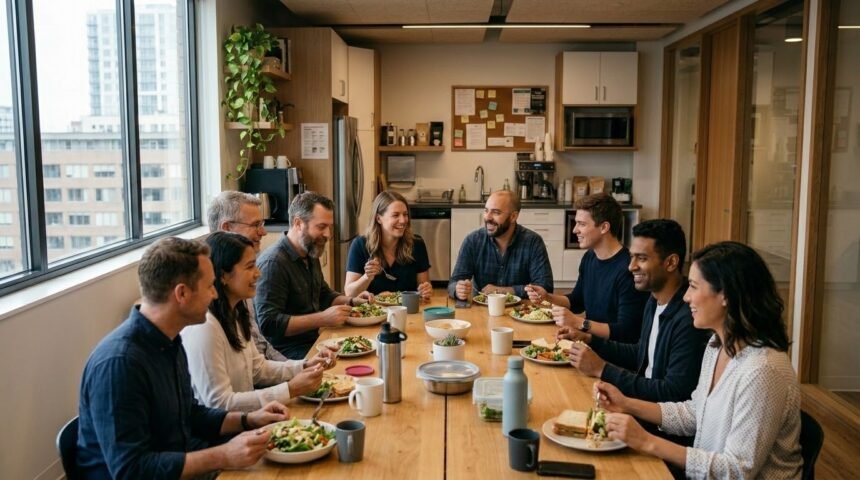
In the era we live in, the traditional office environment has undergone a massive transformation. Nowadays, a modern workplace is defined by distributed teams, asynchronous communication, and the widespread adoption of hybrid work models. Physical contact has been replaced by digital chat channels, while casual hallway conversations have moved to scheduled video conferences.
Notwithstanding such technological advancements, some fundamental human needs remain unchanged. Among the most potent (but frequently undervalued) tools for fostering cohesion is breaking bread together.
After all, eating is a universal human experience, but in the modern workplace, it transcends biological sustenance. Communal dining is a social equalizer and a driver of psychological safety. Thus, understanding the profound impact of shared meals has ceased to be a matter of office perks; rather, it is a strategic necessity.
The Psychology of Communal Dining
The academic term for eating together is “commensality”, derived from the Latin cum (“together”) and mensa (“table”). Anthropological research consistently demonstrates that sharing food creates a unique social bond that few other activities can replicate: the rigid hierarchies of the corporate structure temporarily soften, allowing for an authentic human connection.
From an evolutionary perspective, eating together signifies safety and trust. In ancient human history, sharing a meal meant letting down one’s guard in the presence of others. In the contemporary corporate environment, this evolutionary mechanism manifests as psychological safety: a team that feels safe eating together is more likely to feel safe brainstorming together.
Further out, consuming the same food fosters a sense of equality and shared identity. When executives, mid-level managers, and entry-level interns consume the same meal at the same table, the artificial barriers of status are minimized. The leveling of the playing field encourages open dialogue and reduces the intimidation factor that often stifles junior employees. The psychological benefits of this practice directly impact organizational health, ultimately influencing key performance metrics and reducing employee turnover rates.
The Economics of Connection
Many businesses view corporate catering or subsidized team lunches purely as an item on a balance sheet that can be easily excised during times of fiscal belt-tightening. However, data suggests that the return on investment for shared meals is substantial. A study conducted by researchers at Cornell University examined the eating habits of firefighting units and found that the units that ate together regularly showed significantly higher cooperative behaviors and better job performance compared to those that dined individually.
In an office, team lunches are an incubator for innovation, since in a structured meeting, conversation is strictly dictated by an agenda. Ideas are filtered through the lens of specific objectives, and time constraints often prevent tangential thinking. Conversely, a casual lunch provides the cognitive space for unstructured thoughts to collide. A software engineer chatting with a marketing specialist over a meal might discover a solution to a user-experience flaw simply because the conversation was permitted to drift naturally.
To maximize these economic and collaborative benefits, the meals provided do not need to be extravagant or overly complex. The focus should remain on the shared experience rather than gourmet complexity. E.g., a simple, self-serve grain bowl station featuring versatile grains like easy boil-in-bag rice can serve as a budget-friendly foundation for a team lunch.
Building Inclusive Workspaces
As businesses strive to create more diverse and inclusive environments, food has emerged as a powerful medium for cross-cultural education and empathy. Every culture possesses a distinct culinary heritage, and inviting employees to share their traditional dishes is an invitation to share their personal histories.
Food is a non-threatening entry point for discussing diversity, as it shifts the conversation from abstract corporate policies to sensory experiences. When an employee explains the origins of a specific spice blend or the tradition behind a holiday dish, they are exercising a form of vulnerable leadership. In turn, colleagues who receive this knowledge develop a deeper appreciation for the diverse backgrounds of their peers.
To illustrate how food bridges cultural divides, one needs to look no further than rice. Namely, nearly every culture on Earth relies on a variation of a rice dish as a staple comfort food. In West Africa, one might enjoy a bowl of jollof rice; in India, one might enjoy a bowl of biryani; in East Asia, fried rice is a staple dish; in Latin America, arroz con pate speaks its tale; in Italy, there’s the legendary risotto.
Organizing a multicultural potluck centered around this single ingredient allows employees to showcase their heritage while highlighting a shared global commonality. The resulting dialogue cultivates enhanced workplace social awareness, educating the workforce on cultural nuances and fostering an environment where individuals feel seen, respected, and valued for their unique identities.
Bridging the Digital Divide
While the benefits of shared meals are obvious when a team occupies the same physical office, implementing this practice introduces distinct challenges for leadership within hybrid and fully remote organizations. It’s no rocket science that when employees are scattered across different time zones and geographic regions, the traditional concept of the office lunch hour breaks down. Left unaddressed, remote employees can experience profound professional isolation, which tends to lead to disengagement and a weakened corporate culture.
To combat this, businesses need to intentionally redesign the shared meal for a digital framework. It is insufficient to merely send a food delivery voucher and request that employees eat silently in front of their webcams while reviewing a slide deck. The digital shared meal requires structure, purpose, and a conscious removal of professional agendas.
This can be done in many ways. Some ideas include:
- Asynchronous cooking challenges: Instead of forcing synchronous dining across incompatible time zones, companies can host cooking challenges. Employees are provided a stipend to purchase ingredients for a specific theme and are encouraged to share photos, videos, and recipes in a dedicated digital channel.
- Virtual Lunch and Learn cultural sessions: Leadership can invite team members to volunteer to host short, casual cooking demonstrations via video broadcast. A team member might demonstrate the art of perfecting a family risotto recipe or the precise technique for flipping a Persian Tahdig.
- Structured hybrid rotations: For organizations operating on a hybrid model, specific days of the week should be designated as collaborative anchor days, explicitly linked to a company-provided lunch. If employees are required to commute to an office, that time should be optimized for face-to-face relationship building, with the communal table serving as the primary destination.
The Table Is a Strategic Asset
The modern workplace will undoubtedly continue to evolve, driven by advancements in artificial intelligence, automation, and virtual collaboration tools. Yet, no matter how sophisticated communication technology becomes, it cannot emulate the specific chemical and psychological bonds formed when humans share food.
The communal table is a critical counterweight to the isolation of the digital age. By prioritizing shared meals, businesses invest directly in their cultural foundation. In doing so, they build teams that are more collaborative and culturally aware, and fundamentally more resilient against the pressures of an ever-changing corporate landscape.